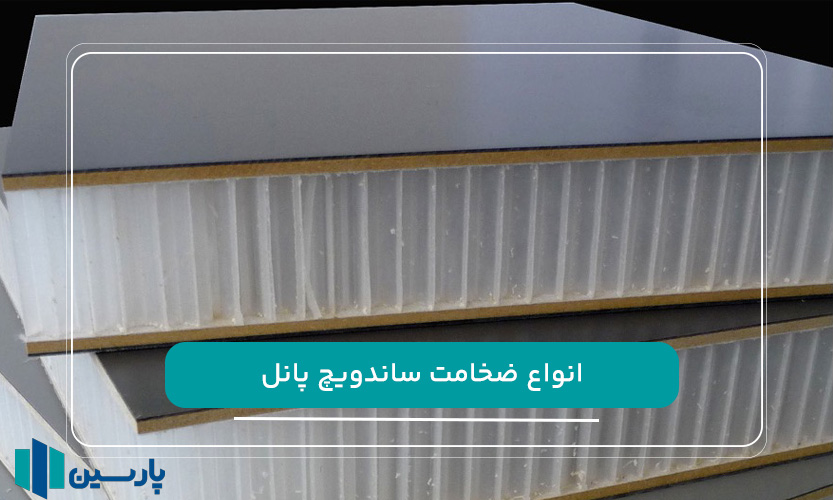
Sandwich panels are produced for a variety of uses and have different applications (learn about Sandwich Panel Applications). One of the factors in selecting and installing sandwich panels is paying attention to their technical specifications. The technical specifications of a sandwich panel include the type of sheets and insulation foam, dimensions and size, thickness, etc. The thickness of sandwich panels is one of the things that is of great concern. In this article from Parsin Gostar, we will examine the thickness of various sandwich panels.
Types of sandwich panel thicknesses and their applications
In standard form, ceiling and wall sandwich panels are produced in thicknesses of 4.5, 6.8, 10.12, and 15 cm, each of which has specific applications. Below, we will discuss each of these thicknesses and their applications in detail.
4 cm sandwich panel
Both ceiling sandwich panels and wall panels are produced with a thickness of 4 cm. The design of the ceiling sandwich panels, due to the trapezoidal steps and the overlap shape, eliminates the possibility of rainwater and snow penetrating inside. These panels are produced in a thickness of 4 cm in the form of double-sided sheets or single-sided sheets. 4 cm wall panels are also used to cover industrial cold stores, cellars, residential and office buildings, and condominiums. The low thickness of these panels allows the user to benefit from a larger space.
5 cm sandwich panel
This thickness of sandwich panels also includes wall and ceiling panels. Despite their thinness and small thickness, these sandwich panels are very resistant and have good strength against impact and pressure. However, the use of such panels makes the structure light and in cases such as earthquakes, they significantly reduce the damage caused by events.
6 cm sandwich panel
6 cm panels are produced in two types of wall and ceiling panels and have extremely high resistance to mechanical loads. These panels can withstand 180 kilos of load per square meter. Their use is common in the construction of ceilings and false walls.
8 cm sandwich panel
Cold storage sandwich panels are produced in thicknesses of 8 to 15 cm. These sandwich panels have the lowest heat, cold, and sound transmission due to their high thickness and type of overlap. Another important point about these panels is that their implementation is different and they do not require substructure. All the doors and openings in this type of panel are filled with silicone and in some places polyurethane foam is injected.
10 cm sandwich panel
These types of panels have a very high resistance to factors such as moisture, chemicals, corrosion, acids, solvents, etc. and do not lose their properties and characteristics under any circumstances. This is why these panels are considered a suitable alternative to concrete structures. In addition, their maintenance costs are much lower than other materials. These types of panels are also used in the construction of various cold stores, refrigeration industries, hotels, shelters, containers, etc.
12 cm sandwich panel
Such structures are resistant to the penetration and growth of bacteria and fungi, microbes, insects, and any type of contamination, while also having very high durability. These panels are generally non-flammable, impermeable, and long-lasting, and are commonly used for things like building clean rooms, laboratory chambers, and food industry production sheds.
15 cm sandwich panel
These types of panels are also more resistant than other models due to their very high thickness. Their thermal conductivity is low and they are considered a type of insulation. These types of panels are used as wall and ceiling coverings and are used in the construction of various industrial, residential, office and shed structures. These panels are generally washable and disinfectable and do not require formwork for installation. Galvanized and polyurethane panels are usually made with this thickness. Despite their high thickness, these panels are very light and are still used in lightening structures.
Thickness of custom sandwich panels
As you know, it is possible to manufacture sandwich panels on a customized basis and with the technical specifications required by the customer. However, panels cannot be produced in any thickness, and the selection of thickness, length, and width of the panels must be defined according to standard conditions so as not to compromise their properties.
Typically, ceiling sandwich panels can be produced from 4 to 20 cm thick. Usually, the width of the panels has a specific standard, but the length of the panels can vary and be in accordance with the customer’s order.
The type of sheet selected, the insulation foam, and the application of the sandwich panel will have an impact on determining its thickness and other technical specifications. Therefore, it is better to pay attention to such things as the type of structure, the level of insulation, and their length and width when selecting the technical specifications of the desired functional panels.
summary
Sandwich panels are considered very practical and modern materials that are produced in accordance with specific standards and have features such as lightness, insulation, long lifespan, ease of installation, etc. These panels are produced in two types: wall and ceiling, with fully defined and standardized technical specifications. One of the most important points in determining the technical specifications of sandwich panels is their thickness. The thickness of the panels is influential in determining their type of use, durability, insulation, and permeability, and for this reason they are of great importance.
- 1 glass wool sandwich panel
- 2 sandwich panel thickness
- 3 decorative panel
- 4 rock wool sandiwch panel
- 5 what is clean room sandwich panel
- 6 acid resistant sandwich panel
- 7 types of sandwich panel
- 8 what is cold storage sandwich panel
- 9 concealed fixation joint
- 10 difference sandwich panel poly yurta poly styrene
- 11 corrosion resistant sandwich panel
- 12 aluminium sandwich panel
- 13 advantage and disadvantages of sandwich panel
- 14 fire resistant sandwich panels
- 15 what is modular sandwich panel
- 16 what is polystyrene sandwich panel
- 17 sandwich panel density
- 18 pvc sandwich panel