Sandwich panels are a type of modern structural construction material that has the advantages of being lightweight, easy to install, low cost, and energy efficient. Sandwich panels come in many types, with clean room sandwich panels being one of the most popular. In this article, we are going to discuss cleanroom sandwich panels and related points. Stay with us.
What is meant by cleanroom sandwich panel?
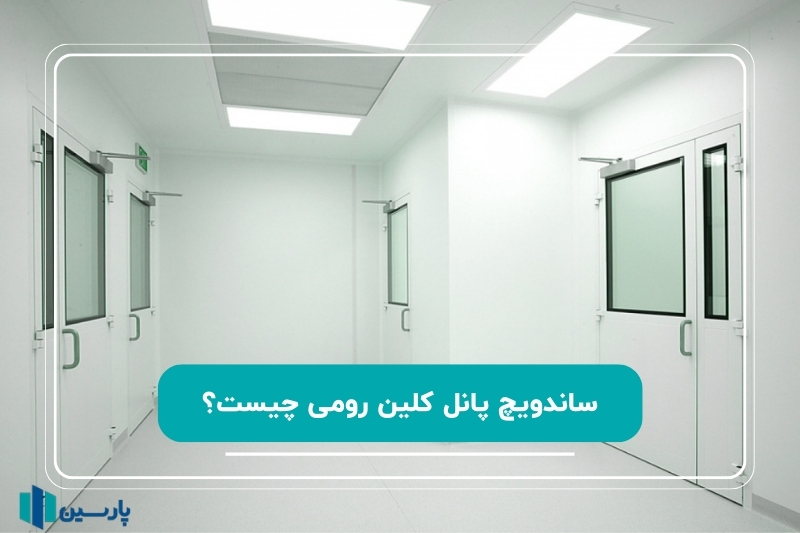
A clean room is a space that is considered very clean from a hygienic point of view, and the concentration of airborne particles in this room is at the level of microns or less. One of the best materials for building such rooms, which are mostly used in laboratory and hospital fields, is sandwich panel. Special sandwich panels used to build clean rooms are called clean room sandwich panels.
One of the most important problems surrounding innovation and production was the presence of airborne particles, which disrupted many of the proportions and results of research and production work. Scientists tried to solve this problem by sealing and insulating the environment, they built rooms where the concentration of pollutants was about 25 microns and they were known as the White Room. As time passed and technology advanced, this level of pollution also became problematic. In the early 1970s, a space was built in which the concentration of pollutants was very low, and the term “clean room” was also used for this purpose. In the 1990s, with the advancement of technology, clean rooms were built using sandwich panels that did not contain even particles with a diameter of five hundredths of a micron.
What is the use of Clean Room Sandwich Panel?
As the name suggests, these sandwich panels are generally used to build rooms with scientific and laboratory applications. For example, in pharmaceuticals, hospitals, medical environments, etc. The most important applications that can be mentioned for these clean room sandwich panels are the construction of clean rooms with the following applications:
- Building a recovery room
- Building a newborn room in a hospital
- Construction of special patient rooms
- Construction of surgery room
- Construction of production rooms in pharmaceutical industries
- Widely used in the aviation industry, including use in navigation systems, overhaul of sensitive and precise parts
- Use in electronics industry
- Use in the semiconductor industry
- Use in precision instrument industries
- Use in optics and laser manufacturing industries
- Use in the oil and petrochemical industries
- Use in food and health industries
Features of Clean Room Sandwich Panel
Clean room sandwich panels have special features that distinguish them from other sandwich panels. In this section, we will examine the most important features of this type of sandwich panel.
Appearance features
Clean Roman sandwich panels must have completely smooth sides, free from any form, groove or curvature, and are generally produced in light colors. The reason for this feature is that these sandwich panels are free from any type of contamination (germs, fungi and viruses). The material of Clean Roman sandwich panels is also generally Aluzinc and galvanized with polyurethane insulation. This feature helps the clean room become a completely sterilized environment, suitable for use in hospitals, pharmaceutical factories, electronics and microelectronics industries, food and health industries, etc.
The joints of Clean Room sandwich panels are designed in a way that provides good overlap and prevents contamination from entering the interior. No bolts or nuts are used in the installation of these sandwich panels. These sandwich panels have a groove and a tongue and are locked together when connected. Then, the connection site is completely sealed and impenetrable with a special tool.
Clean Room Sandwich Panel Material
Clean room sandwich panels are made with a middle layer of polyurethane. This material is a type of insulating foam in which all pores are closed and is also considered a type of thermal insulation. That is why clean room sandwich panels can withstand temperatures of 100 to 110 degrees Celsius.
Cleanroom sandwich panels have three layers, usually made of metal sheets for the outer and inner layers, and polyurethane foam in the middle layer. Also, the density of polyurethane foam in cleanroom sandwich panels is 38 to 42 kg/m3.
Dimensions and thickness of clean room sandwich panels
In standard form, the thickness of these sandwich panels is often 4 to 15 centimeters, which are made based on customer orders. The length and dimensions of the sandwich panel can also be changed according to customer orders.
Weight of Roman sandwich panel
Cleanroom panels are generally very lightweight. In standard form, the weight of these sandwich panels is 12 to 30 kg/m2.
Equipment required for building a clean room
In these rooms, the amount of dust and microbes, airborne particles and chemical vapors, and any other contaminants are kept at a very low and controlled level. To achieve this goal, air conditioners, filter units, filter boxes, and other special clean room equipment are usually used in rooms made of clean room sandwich panels. The type of construction of clean rooms and the equipment placed in them will depend on their application in the intended industry.
To construct a clean room, smooth galvanized and aluzinc sandwich panels are used for the walls and ceiling sandwich panels are used for the ceiling. PVC and resin are usually used for the floors of these rooms.
Using double-glazed windows, round profiles, and special angled joints alongside cleanroom sandwich panels, a cleanroom is equipped and put into operation according to the intended application.
Types of cleanroom sandwich panels
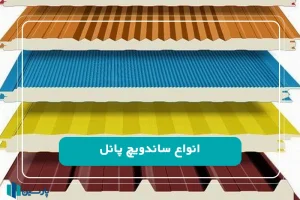
Clean room sandwich panels are usually produced in two types: wall sandwich panels and ceiling sandwich panels. Thus, in the construction of clean rooms, these sandwich panels with special features can be used on the side surfaces and ceiling of the room.
Advantages of using Clean Room Sandwich Panels
Using these sandwich panels to build a clean room comes with many benefits, including the following:
- High resistance to fire
- Quick and easy installation
- Proper insulation
- Resistant to moisture penetration, insects, fungal growth, etc.
- Saving time and construction costs
- Can be repaired and rebuilt
- Environmentally friendly
Cleanroom sandwich panel price
The price of clean room sandwich panels depends on various factors. The most important factor in determining the price of this type of sandwich panels is the price of the raw materials used to produce them. The extreme fluctuations in the market make it impossible to have a specific price for this product, and everything is determined by the conditions at the time of production of the clean room sandwich panel.
The type of profile, the material of the sheets used in the construction, the thickness of the sheets, the color of the sheets, the thickness of the insulation, the density of the insulation, and the production area are among the factors that affect the final price of clean room sandwich panels.
summary
One of the most well-known types of sandwich panels are cleanroom sandwich panels, which are used to build sterilized and insulated rooms. These cleanrooms have special applications in industries such as aircraft manufacturing, petrochemical, pharmaceutical, medical, food and hygiene industries, etc.
- 1 glass wool sandwich panel
- 2 sandwich panel thickness
- 3 decorative panel
- 4 rock wool sandiwch panel
- 5 what is clean room sandwich panel
- 6 acid resistant sandwich panel
- 7 types of sandwich panel
- 8 what is cold storage sandwich panel
- 9 concealed fixation joint
- 10 difference sandwich panel poly yurta poly styrene
- 11 corrosion resistant sandwich panel
- 12 aluminium sandwich panel
- 13 advantage and disadvantages of sandwich panel
- 14 fire resistant sandwich panels
- 15 what is modular sandwich panel
- 16 what is polystyrene sandwich panel
- 17 sandwich panel density
- 18 pvc sandwich panel