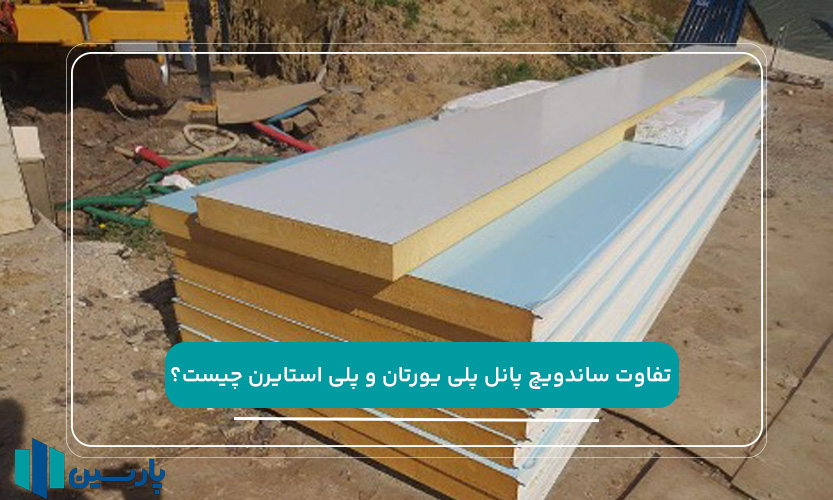
Polyurethane and polystyrene sandwich panels are two of the most common types of sandwich panels used in various structures. Sandwich panels consist of two metal sheets and an insulating foam. Polyurethane and polystyrene are the two primary materials used as the insulating core in the manufacture of sandwich panels. Each of these raw materials has unique characteristics that determine the use of sandwich panels. Previously, in Parsin Gostar articles, we have introduced Polyurethane Sandwich Panels and Polystyrene Sandwich Panels In this article, we are going to discuss the differences between polyurethane and polystyrene sandwich panels.
The difference between polyurethane and polystyrene sandwich panels
The insulation core is one of the most important components of a sandwich panel, which brings special characteristics to it. As we mentioned, polystyrene and polyurethane are two common choices as insulation cores in the manufacture of sandwich panels. To understand the difference between sandwich panels made from each of these materials, we will examine the characteristics of sandwich panels made from these materials individually.
Polyurethane sandwich panel feature
Polyurethane sandwich panels are sandwich panels that use polyurethane foam as an insulating core. These sandwich panels are very lightweight and have other features such as high resistance to moisture, water, and chemical penetration, as well as high-temperature insulation and fire resistance. In fact, polyurethane foam has greater fireproofing and fireproofing properties than other foams used as insulation in sandwich panels.
Sandwich panels made of polyurethane foam have a wide variety of colors and sizes, which cover every taste well. In addition, due to its excellent features, it has wider applications.
Features of polystyrene sandwich panels
Polystyrene is the same as Unolite. Polystyrene foam is one of the most common and cheapest insulating foams in the construction of sandwich panels. Sandwich panels made from this foam are used in the construction of various structures and in the form of wall and ceiling panels. Polystyrene sandwich panels are completely environmentally friendly and are available in three types: regular, resistant and expansion (Unolite). These sandwich panels are very light and weigh less than other prefabricated panels. Polystyrene sandwich panels are considered good insulators for heat and water penetration. But these panels are very vulnerable to fire and high heat, and the insulation foam melts at high temperatures.
The main differences between polyurethane and polystyrene sandwich panels
These sandwich panels are similar in many ways, including light weight, use as wall and ceiling panels, and moisture and heat insulation, but the main differences between these panels can be found in the following.
Type and amount of insulation
Usually, prefabricated panel insulation foams are selected according to their features and applications. In terms of sound and thermal insulation, polyurethane foams have a significant advantage over polystyrene foams. Therefore, if you are looking for better and more insulation, you should choose polyurethane sandwich panels. In terms of moisture insulation, polyurethane foam also performs slightly better than polystyrene foam. Therefore, in general, the insulation properties of polyurethane are far greater than polystyrene.
Strength and durability
The next important point in choosing insulation is its strength and durability. In this case, it should be noted that polyurethane foams have greater resistance and strength against impact, pressure, and the penetration of contaminants, including fungi and bacteria.
Resistance to heat and flame
Among the most important features that are examined in sandwich panels is their resistance to heat, temperature, and flame. Sandwich panels made of polyurethane foam are considered fireproof or refractory. Polystyrene sandwich panels will also have adequate resistance if they are thick. However, polystyrene is vulnerable to high temperatures and direct flame and will melt if exposed to fire for a long time.
Polyurethane foams also do not produce toxic gases when burned, which makes the panels made from them safer. In the case of sheds and structures where the risk of fire is high, it is better to use polyurethane sandwich panels.
price
Polyurethane sandwich panels have significant advantages over polystyrene sandwich panels in terms of features and applications, and are therefore more expensive. However, factors such as lightness, cheapness, ease of transportation, installation, and recyclability make polystyrene sandwich panels more popular and have more fans. So, if you are looking for cheaper options and the structure to be built does not pose a high risk in terms of fire, polystyrene sandwich panels will be the best option.
summary
Polystyrene and polyurethane sandwich panels are two of the most widely used sandwich panels, which differ significantly in terms of features, production standards, and application. In this article, we will discuss the major differences between polystyrene and polyurethane sandwich panels.
- 1 glass wool sandwich panel
- 2 sandwich panel thickness
- 3 decorative panel
- 4 rock wool sandiwch panel
- 5 what is clean room sandwich panel
- 6 acid resistant sandwich panel
- 7 types of sandwich panel
- 8 what is cold storage sandwich panel
- 9 concealed fixation joint
- 10 difference sandwich panel poly yurta poly styrene
- 11 corrosion resistant sandwich panel
- 12 aluminium sandwich panel
- 13 advantage and disadvantages of sandwich panel
- 14 fire resistant sandwich panels
- 15 what is modular sandwich panel
- 16 what is polystyrene sandwich panel
- 17 sandwich panel density
- 18 pvc sandwich panel