Corrosion-resistant sandwich panels are a type of prefabricated panel that is highly resistant to rust, rot, and moisture. Due to their positive characteristics, these types of panels have successfully replaced traditional materials in recent years and are used in the facades and interiors of various buildings. In this article, we intend to introduce corrosion-resistant panels, their features, and important points about them.
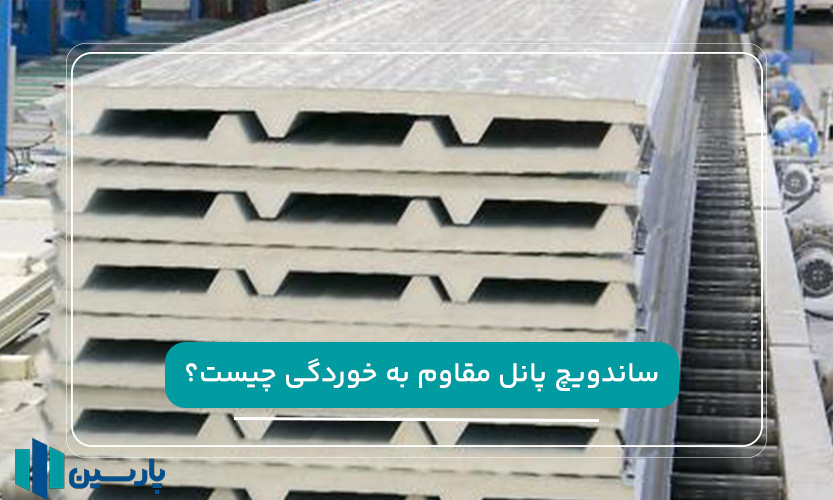
These types of prefabricated panels are made from materials that are anti-corrosion, anti-humidity, and highly resistant to chemicals. Corrosion-resistant sandwich panels consist of three layers, including insulating foam and two metal sheet covers that enclose the insulating foam. Galvanized and aluzinc sheets are usually used to make such panels.
Features of corrosion-resistant sandwich panels
These panels are made of high-quality and resistant materials, which is why they have good resistance to environmental factors. Usually, the thickness of such panels is 45 microns or more. In these panels, the galvanized sheet coating is 45 microns and the organic coating is 25 microns. This thickness can be changed up to 200 microns depending on the customer’s needs.
These panels have other features such as resistance to heat and cold, moisture and humidity, resistance to UV rays and other chemicals.
Corrosion-resistant sandwich panels are produced in a variety of designs and colors and are used on the interior and exterior of buildings.
The outer covering of these panels may be galvanized, aluzinc or aluminum. The most important features of such panels include light weight and energy saving due to low heat transfer coefficient.
Application of anti-corrosion sandwich panels
The best and highest quality raw materials are used in the manufacture of corrosion-resistant sandwich panels, and for this reason, such panels are usually considered among the highest quality prefabricated panels. Due to their practical features, these panels are usually used in building facades that are subject to wear and tear, interior facades, workshop environments, or other places that require proper insulation and where there is a possibility of corrosion of materials. These sandwich panels are considered the best choice for roof and wall coverings.
Advantages of using anti-corrosion sandwich panels
These panels have advantages such as high resistance compared to other types of prefabricated panels. The most important advantages that can be mentioned for using anti-corrosion prefabricated panels are:
- Light and easy to install
- High durability and strength
- Suitable insulation against heat, cold, UV rays, moisture, chemicals, etc.
- Easy to carry and move
- Reasonable price
- Preventing energy waste
- Good sound insulation
- A single-handed and beautiful appearance
- High variety in design and color
- High resistance to pressure and impact
- Antibacterial properties
- High safety against fire, chemicals, etc.
- Eco-friendly and recyclable
The best sheets for exterior cladding of anti-corrosion panels
Different outer coatings can be used for anti-corrosion panels. The selection of these coatings is generally based on the type of application and conditions of use of the sandwich panel. The materials that are generally used as outer coatings for these panels are:
Polyester
This type of coating has the highest resistance in different climatic conditions. High flexibility, good thermal balance, impermeability to moisture and humidity are among the most important features of such a coating. Polyester coating can be used for panels inside or outside the building. This material is usually used in the manufacture of ceiling panels.
PVDF
This material has the highest resistance to corrosion. PVDF is resistant to various weather conditions, chemicals and synthetic oils. It also has good resistance to chemicals and ultraviolet rays and has a glossy and transparent color. These panels are usually used for ceilings and walls of luxury buildings.
Corrosion-resistant sandwich panel price
These panels are also priced according to various factors, the most important of which are the type of insulation foam, the type of covering sheet, the thickness of the panel, its dimensions, and the standard and quality of its construction.
summary
One type of sandwich panel is corrosion-resistant panels. The most important factor that creates this feature in a corrosion-resistant sandwich panel is its coating. Prefabricated corrosion-resistant panels are made from different raw materials that have specific physical and technical properties for them. The most important application of these panels is in the interior and exterior facades of buildings and environments where they deal with water, chemicals, and acids. The price of these prefabricated panels is determined by factors such as the type of insulation, type of exterior coating, dimensions, and quality of construction.
- 1 glass wool sandwich panel
- 2 sandwich panel thickness
- 3 decorative panel
- 4 rock wool sandiwch panel
- 5 what is clean room sandwich panel
- 6 acid resistant sandwich panel
- 7 types of sandwich panel
- 8 what is cold storage sandwich panel
- 9 concealed fixation joint
- 10 difference sandwich panel poly yurta poly styrene
- 11 corrosion resistant sandwich panel
- 12 aluminium sandwich panel
- 13 advantage and disadvantages of sandwich panel
- 14 fire resistant sandwich panels
- 15 what is modular sandwich panel
- 16 what is polystyrene sandwich panel
- 17 sandwich panel density
- 18 pvc sandwich panel