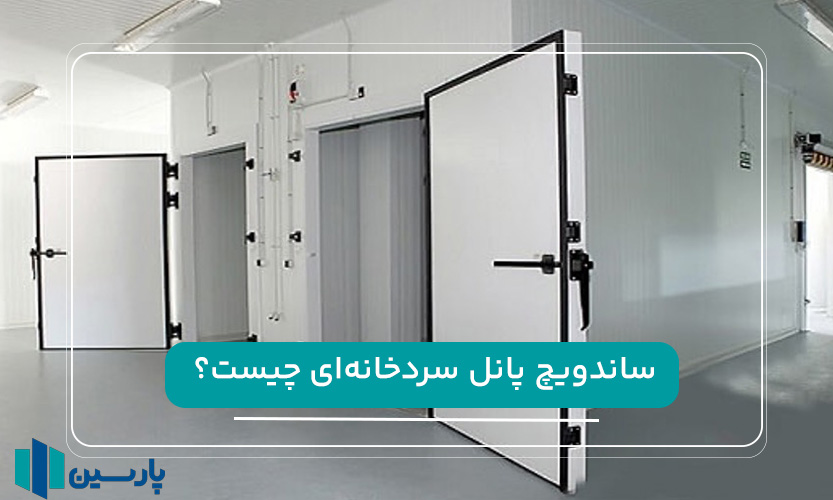
One of the types of practical sandwich panels is the cold storage sandwich panel. As the name suggests, this type of sandwich panel is generally used as the primary material for cold storage. In fact, such panels are used to build special rooms for products that need to be kept away from heat. In this article from Parsin, we will introduce cold storage sandwich panels, their applications, and features.
What is a cold storage sandwich panel?
Cold storage sandwich panels are generally used to build warehouses used as cold storage for heat-sensitive products, special chambers for transporting heat-sensitive products, and dry product warehouses.
The most important application of cold storage sandwich panels is in the construction of grain warehouses, agricultural products and food industries. Generally, these sandwich panels consist of a middle core of polyurethane or polystyrene and metal sandwich covers.
Features of cold storage sandwich panels
The most important features that can be considered for such sandwich panels are washability and proper insulation. The washability of these panels allows the user to remove contaminants by washing the panels when necessary. Given that the most important application of these types of panels is in the food and agricultural industries, their sterility and cleanliness will be of great importance, and this washing capability can well meet such expectations.
Another feature of cold storage panels is that they do not allow bacteria, fungi, or pathogens to grow in them. The installation of these panels is such that there are no openings for the growth of fungi or bacteria, while proper insulation of cold storage sandwich panels greatly reduces the possibility of moisture, dust, insects, and vermin intrusion.
The high resistance of these sandwich panels is another feature that protects this product against factors such as pressure and impacts. In fact, any possibility of penetration into these sandwich panels is almost eliminated.
Cold storage sandwich panels are considered good insulators for heat and cold, and for this reason, there is no possibility of hot air penetrating the cold storage environment due to the use of this product. In fact, the insulating properties of cold storage sandwich panels make it impossible for any type of temperature changes in the cold storage environment.
The most important application of cold storage sandwich panels
As we mentioned, the most important application of cold storage sandwich panels is in food and agricultural industry warehouses, however, a wide range of applications can be considered for this product, including:
- Industrial cold stores
- Mobile cold storage rooms
- Cabins assembled on trucks, vans, vans and trailers for transporting products
- Construction of freezing tunnels
- Drug storage warehouses
- Chemical storage warehouses
- Use in some parts of livestock and poultry farming
- Industrial slaughterhouses
- Mushroom breeding hall
- Food industry factories
- Sausage and hot dog factories
- Chicken, meat, etc. packaging workshops
- Hospital and medical industries
Technical specifications of cold storage sandwich panels
Cold storage sandwich panels are generally made of polyurethane or polystyrene cores. These two insulations, with their low thermal conductivity and good insulation properties, are the best choices for cold storage sandwich panels. Since cold storage sandwich panels are used to create a cold-retaining environment, polyurethane is a better choice as an insulating core for these panels because it has a lower heat transfer coefficient than other options.
The use of polyurethane reduces the thickness of cold storage sandwich panels, the standard thickness for cold storage thermal insulation foams is about 3.5 cm. In this way, less space is occupied by the sandwich panels and provides the user with optimal space for use.
The best sheets used in the manufacture of cold storage sandwich panels are aluzinc and galvanized sheets. These sheets ensure that the cold storage sandwich panel has adequate resistance to environmental conditions, including moisture, corrosion, and heat. These sheets are made into male and female cold storage panels to maintain a unified appearance, prevent the formation of grooves and gaps during installation, and prevent the growth of fungi and bacteria.
When installing these panels, insulating adhesives are usually used for sealing, which is the main factor in the insulation state for the environment.
Types of cold storage sandwich panels
Cold storage sandwich panels are produced in different types, depending on their diverse applications, including:
- Suitable panels for mobile cold storage
- Suitable panels for fixed cold stores
- Freezing tunnel construction panels
- Cold storage panel specially designed for storing food and vegetables, including fruits and vegetables.
- Panel for sub-zero cold storage
- Panel for cold storage above zero degrees
Advantages of using cold storage sandwich panels
The use of special cold storage sandwich panels in various industries comes with many benefits, the most important of which are:
- High resistance to water and chemical penetration
- Proper thermal insulation and prevention of energy waste
- Resistant to corrosion and rust
- Ease of installation and speed of implementation
- Easy maintenance and repairs
- Fireproof, non-combustible and slow-burning construction materials
- Long life
- Washable and sterilizable
- Fast and easy transportation
- Lightweight and cost-effective compared to traditional building materials
Cold storage sandwich panel price
The price of cold storage sandwich panels is determined by factors such as: foam density, foam thickness, type of insulation foam, cladding material, thickness of cladding sheets, custom panel dimensions, and manufacturer brand.
You can also use second-hand cold storage panels to save costs. Parsin Gostar editorial team has provided a complete introduction to sandwich panels and their types on the sandwich panel introduction page. We recommend that you do not miss this article.
- 1 glass wool sandwich panel
- 2 sandwich panel thickness
- 3 decorative panel
- 4 rock wool sandiwch panel
- 5 what is clean room sandwich panel
- 6 acid resistant sandwich panel
- 7 types of sandwich panel
- 8 what is cold storage sandwich panel
- 9 concealed fixation joint
- 10 difference sandwich panel poly yurta poly styrene
- 11 corrosion resistant sandwich panel
- 12 aluminium sandwich panel
- 13 advantage and disadvantages of sandwich panel
- 14 fire resistant sandwich panels
- 15 what is modular sandwich panel
- 16 what is polystyrene sandwich panel
- 17 sandwich panel density
- 18 pvc sandwich panel