One of the applications of sandwich panels is the construction of prefabricated cabins, and a cabin built using sandwich panels is referred to as a sandwich panel cabin. Sandwich panel cabins are among the most popular and high-demand types of cabins. The main reason for their popularity lies in the unique advantages and features they gain from their panel-based structure. In this article, Parsin Gostar aims to examine sandwich panel cabins and their applications.
What is a sandwich panel cabin?
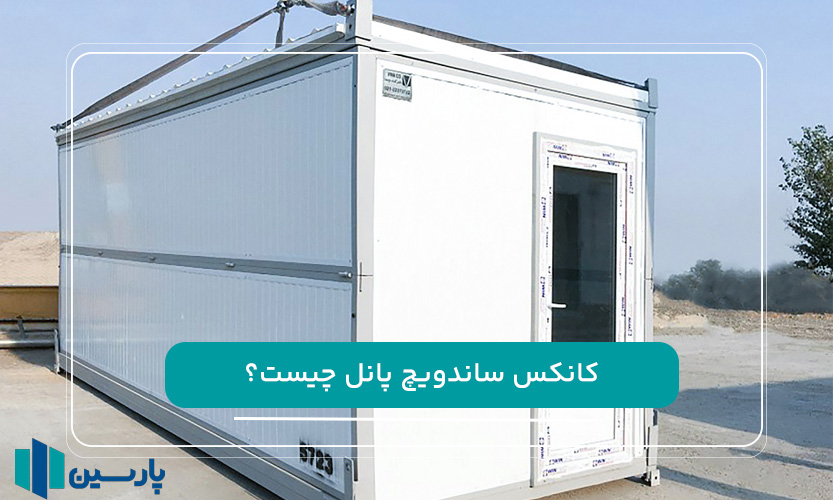
A cabin is a small room or enclosure that has a variety of uses and can be moved and transported. Cabins come in many different types and are made from a variety of materials. A sandwich panel cabin is a type of cabin whose walls and roof are made of sandwich panels. The most important features of such containers are their lightness and easy transportation, proper insulation against cold, heat, and humidity, fireproofing, and compliance with health and safety standards.
Application of sandwich panel cabin
Since sandwich panel cabins have a special structure that is made entirely of prefabricated panels, they have unique features that determine their application. The use of such cabins in various climatic conditions is common in industrial environments, workshops, military bases, barracks, laboratories, cold storage, emergency rooms in deprived areas, the back of trailers, guard rooms, use as mobile classrooms in deprived areas, field hospitals, and construction projects, etc.
Advantages of using sandwich panel cabins
The most important advantages of using such cabins in different conditions and situations are as follows:
- Save energy and reduce CO2 emissions
- Reducing construction costs
- Reducing the construction time of cabin structures
- Easy and low-cost maintenance conditions
- Suitable insulation against heat, cold, moisture, corrosion, oxidation and chemicals
- Can be used in any climate and weather conditions.
- High resistance to earthquakes
- Variety of colors and designs
- High flexibility for use in specific designs
- Low cost and economical compared to traditional materials
- Washable and sterilizable
Types of sandwich panel cabins
Sandwich panel cabins come in different types. These cabins are divided into two categories: fixed cabins and mobile or wheeled cabins, depending on whether they are fixed or mobile. Transporting mobile cabins is much easier and faster than fixed cabins. In terms of appearance, sandwich panel cabins are divided into three categories: simple, decorative, and villa cabins. The price of each type of sandwich panel cabin is determined according to its type and application.
Sandwich panel cabin price
As we mentioned, there are different types of sandwich panel cabins and different types of sandwich panels are used in their construction. The technical specifications and implementation method of prefabricated panels as raw materials for cabin construction, as well as the dimensions and type of cabin, are influential in determining its price. In the construction of sandwich panel cabins, various types of aluzinc, galvanized and aluminum sheets are usually used. Composite can be used on the exterior of the sandwich panel cabin and MDF and PVC on its interior.
Comparison of conventional cabin and sandwich panel cabin
Perhaps the most important difference between these two types of cabins is their insulation properties. Polyurethane insulation is generally used in sandwich panel cabins, while polystyrene insulation is a more common choice for galvanized or conventional cabins. Polyurethane insulation is considered thermal insulation, while polystyrene insulation is considered moisture insulation.
In sandwich panel cabins, the outer and inner walls are made of galvanized sheets, but in conventional cabins, only the outer walls are made of galvanized sheets. Sandwich panel cabins do not require interior wall cladding, while in conventional cabins, wall cladding is used on the inner walls. Sandwich panel cabins are more expensive compared to conventional cabins.
summary
Sandwich panel cabins are considered the best choice for a variety of applications in different climatic conditions. Such cabins are considered a better choice compared to conventional cabins due to their features such as heat and cold insulation, moisture insulation, rust and corrosion resistance, and fire resistance. Other features such as speed of construction, reduced construction costs, and ease of transportation, along with the lightness of the structure, can make these cabins an excellent and practical choice.
The choice of the type of sandwich panels and insulation in sandwich panel cabins is determined by their application as well as the desired technical specifications.
Sandwich panel cabins are more expensive than regular cabins due to their unique features. The article discusses all the features of sandwich panel cabins.