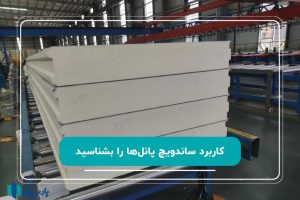
Sandwich panels generally have high strength against external pressures; however, failure to comply with standard and safety precautions in transporting sandwich panels can cause damage to the panel coating or insulation foams.
Damage to these panels can affect features such as insulation, waterproofing, or acid resistance. The transportation instructions for sandwich panel types include all stages of packaging, loading, transportation, and unloading.
Experts recommend that experienced and specialized workers be used in the transportation of sandwich panels to prevent damage to the prefabricated panels. In this article from Parsin, we will discuss important points that you should pay attention to when transporting and moving sandwich panels.
The most important points for transporting sandwich panels
Sandwich panels are transported and handled from the production stage to the installation of loads. Observing the transportation and handling tips will reduce the possibility of damaging the panels to zero. Damage to prefabricated panels means disruption of the unique characteristics, which will be the main factor in using these modern materials instead of traditional materials.
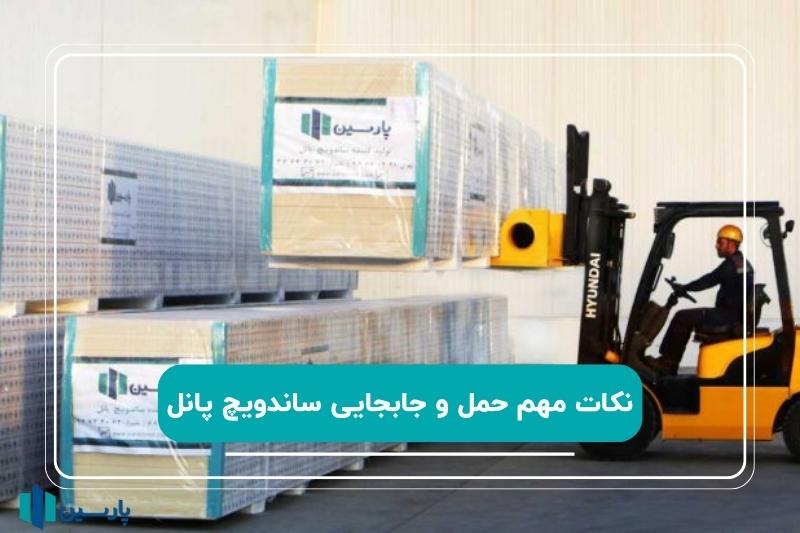
Sandwich panels enter the transportation process after being produced in the factory. The panels are usually packaged in polyethylene bags. In this way, possible damage during transportation in the factory is largely prevented. The panels are usually loaded and unloaded by a loader or forklift. These panels are placed on different pallets depending on the type, thickness and number. A pallet is a sturdy and stable structure that is used in various industries for the safe movement of products and is usually made of raw wood, plastic or recycled materials. The most important points to note when transporting prefabricated panels are as follows:
Packaging at the factory
One of the most important processes for protecting prefabricated panels is packaging them, which are generally packaged in polyethylene bags in packs of 3 or 6. Usually, the packaging of prefabricated panels is done mechanically, and in the production line, after the production is completed, the panels are entered into a special packaging tunnel and placed in a polyethylene or protective foil cover with controlled heat.
The choice of packaging type depends on the type of panels and their application. For example, double-sided nylon or cold storage sandwich panels are generally packaged with foil. However, polyethylene materials are used for packaging in aluminum or aluzinc sandwich panels.
The packaged panels are placed on pallets for easier transportation, and a forklift or crane is used to transport them.
Sandwich panel transportation
After the panels leave the production line, the first stage of their transportation begins. Generally, after production, the panels are transferred to a warehousing unit and from there to be sold to the customer or market. Observing important safety and maintenance tips when transporting sandwich panels will minimize damage caused by transportation, such as scratches on the panels, damage to the panel coating, etc. The most important tips that must be observed when transporting panels are:
- Vehicles used to transport sandwich panels must be equipped with special tents on the top and sides of the load, so that the panels are well protected against factors such as wind and rain.
- Loading and unloading of panels at each stage of transportation is done with the help of a crane or forklift. For additional protection of the load, disposable lifting belts, cables or chains are used when moving pallets.
- The floor of transport vehicles must be completely flat, clean, and free of any bumps to prevent unwanted damage to the panels.
- Foam padding or polystyrene pads can be used to further protect the panels during transportation.
- Panels with mineral wool insulation cores must not protrude from the vehicle. They are also prohibited from being transported in open-top vehicles.
- The driver of the vehicle transporting prefabricated panels must have the necessary license to carry out the transportation process of these products.
Maintenance of sandwich panels
When prefabricated panels are shipped from the factory to the warehouse or project, they must be stored and handled with care. The most important points in this regard are:
- Prefabricated panel packages should be placed on a sloping base to prevent rainwater from penetrating the lower sections. Also, if the panels are stored outdoors, the panel packages should be protected from environmental factors such as rain, sun, dust, etc. Tarpaulin tents or other covers are used for this purpose.
- If prefabricated panels are to be stored for a long period of time, it is best to remove their protective coating.
- If the sandwich panels are stored in humid and humid environments, it is better to create a ventilation hole on the protective cover so that air circulates well and moisture evaporates.
- Necessary precautions must be taken to protect sandwich panels from impact and pressure.
- When using panels, cutting or machining on the panels must be done with appropriate tools and with sufficient safety to prevent damage to other parts of the panel.
- When storing and maintaining panels, the number of panels stacked on top of each other depends on the weight of the panels. Generally, this number varies between 3 and 12 panels.
- The thin coating that is placed between the panels should be removed immediately upon installation and should not remain on the structure for more than two weeks.
- When removing panels from each other, you must be careful to prevent the panel covering from dragging on the panels below, as this will cause scratches on the panel covering.
- Avoid walking on the panels during installation.
- It is best to unload prefabricated panels at the closest point to the installation site to prevent damage, impact, or unwanted collisions with the panels.
summary
Sandwich panels, due to their characteristics, must be transported and handled in a standard and principled manner, observing safety precautions. These precautions include all safety precautions for transportation and handling from the production line to installation. Following these tips will help ensure that prefabricated panels are installed in place without any damage. Possible damage such as pressure, impact, scratches, etc. will affect the properties of the panels such as insulation, resistance to moisture, corrosion, decay, etc.