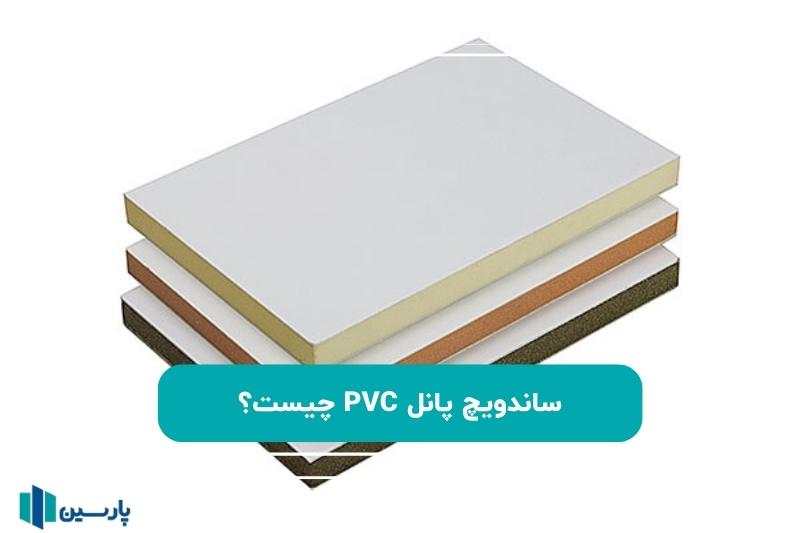
One type of sandwich panel is prefabricated PVC panels, which are structurally similar to other types and are produced in multiple layers. In this type of panel, fiberglass sheet is used as the insulation core cover. The unique properties of PVC make it a suitable alternative to materials such as clay, concrete, wood, etc. as a new building material.
PVC sandwich panel structure
PVC sandwich panels are made of aluminum foil, paper and cardboard on one side and trapezoidal PVC sheet on the other. In these panels, the foam used in the middle layer generally has a density of 50 to 60 kg and is considered a lightweight foam. PVC PET and PIR foams or polyurethane are usually used in these panels. In addition to being lightweight, these foams are highly durable and have a longer lifespan than types of sandwich panels. ASA resin is also used for the outer coating of these sandwich panels, the most important features of which are the lack of physical changes in adverse weather conditions, high resistance to corrosion, abrasion, acidic and chemical agents. These sandwich panels are highly resistant to moisture, heat, cold, ultraviolet rays, and sunlight.
PVC sandwich panels are used in two types of wall and ceiling panels and are used in the construction of various industrial structures, shelters, cold storage, clean rooms, enclosures, containers, etc.
Advantages of using PVC sandwich panels
This type of sandwich panels, like other types of these products, has unique features and benefits. The most important benefits of using PVC sandwich panels are as follows:
- The strength of PVC sandwich panels is approximately twice that of Aluzinc sandwich panels.
- Its structure uses reinforced glass fiber and epoxy resin.
- These panels are lightweight and have high mechanical properties.
- It has good resistance to decay and corrosion.
- Due to properties such as non-conductivity of electrical current, these panels are widely used in the electronics industry.
- They have high performance.
- It is considered a good sound and heat insulator.
- The PVC used in the manufacture of these panels is considered to be UV-stabilized.
- Easy installation and high efficiency
- Health and underweight
- High resistance to earthquakes and landslides
- Suitable resistance to natural factors such as wind, rain and sunlight
- High strength and durability against corrosion, rot, mold, chemicals and acids
- Washable and long lasting
- fireproof
- Compatible with polyester, vinylester and epoxy materials
- Easy to cut and rollable
- Affordable and cheap
Technical characteristics of PVC sandwich panels
The most important technical features of PVC sandwich panels are:
- The best operating temperature for this type of prefabricated panels is between +70 and -40 degrees.
- These sandwich panels have a load capacity of up to 150 kilograms per cubic meter.
- The fire rating of PVC sandwich panels is B1 and its density is 1.41 grams per cubic centimeter.
- Its thermal coefficient is about 0.020 m2k/w and its impact resistance is about 5.42 MPa.
The most important application of PVC sandwich panels
PVC sandwich panels are produced in wall and ceiling types, and their most important applications, based on their characteristics, include the following.
- Used in the construction and decoration of all types of supermarkets, office, commercial, residential buildings, restaurants, industrial and manufacturing workshops, etc.
- Due to its high flexibility and low price, it is very common to use it in water and sewage piping.
- Use in vertical window cutting
- Use in interior decoration of walls, doors, windows, ceilings, etc.
- Use in marine industries and ship and boat hull construction
- Use in transportation industries
PVC sandwich panel price
Like other types of sandwich panels, the price of PVC sandwich panels also depends on various factors such as the thickness of the foil sheet, insulation foam, dimensions and area of the order, number of panels, profiles used, number of bends and type of profile, etc. Since the price of raw materials for construction is very unstable in the current situation, it is not possible to consider a specific price for PVC sandwich panels.
summary
PVC sandwich panels are a type of prefabricated sandwich panels that are produced in wall sandwich panels and ceiling sandwich panels. This sandwich panel is produced in various thicknesses and its most important feature in manufacturing is the use of PVC sheet as an insulating coating. Due to the unique features that PVC panels have, their use is very common in various industries.
- 1 glass wool sandwich panel
- 2 sandwich panel thickness
- 3 decorative panel
- 4 rock wool sandiwch panel
- 5 what is clean room sandwich panel
- 6 acid resistant sandwich panel
- 7 types of sandwich panel
- 8 what is cold storage sandwich panel
- 9 concealed fixation joint
- 10 difference sandwich panel poly yurta poly styrene
- 11 corrosion resistant sandwich panel
- 12 aluminium sandwich panel
- 13 advantage and disadvantages of sandwich panel
- 14 fire resistant sandwich panels
- 15 what is modular sandwich panel
- 16 what is polystyrene sandwich panel
- 17 sandwich panel density
- 18 pvc sandwich panel