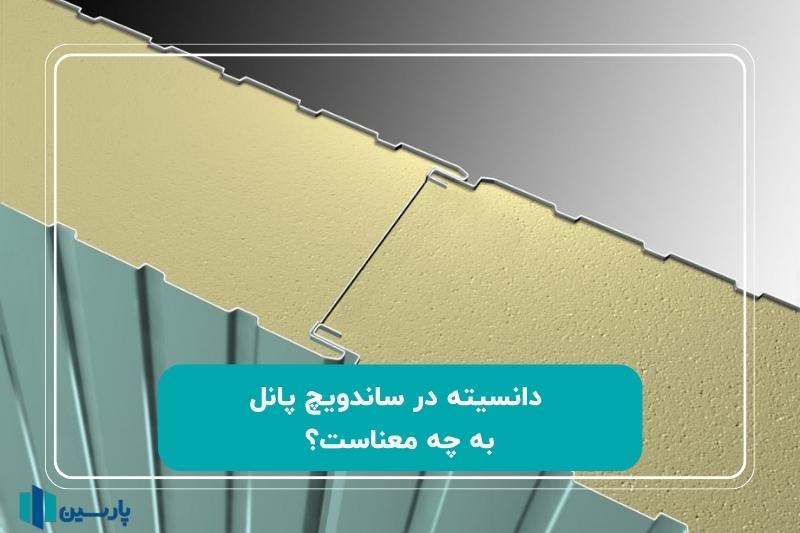
When purchasing sandwich panels, one of the most important issues to consider is density. What density is, what it means, and how it affects the selection of sandwich panels is a topic that we will discuss in this article. Sandwich panels are generally available in the market with various densities. You can choose a model with the appropriate density depending on the application you intend for the sandwich panel. In fact, density is the density whose value is related to the strength of the sandwich panel.
What is density?
We know that sandwich panels consist of two parts: insulation and metal. Density is a unit used to indicate the density of the insulation part of sandwich panels. Density refers to the amount of mass per unit volume and is actually the same as density. The heavier an object is, the greater its density or mass. One way to estimate the strength and durability of prefabricated materials is to know their density. The higher the density, the greater the strength and durability of the product.
Where is density used?
As we said, density is a very important parameter in choosing sandwich panels and indicates the density of the insulation section. The density or density of the insulation plays the largest role in the heat transfer coefficient and sound transmission coefficient of the sandwich panel. So that the higher the density of the sandwich panel’s middle insulation, the better it will be for heat and sound insulation, and sandwich panels with a low middle core density will have high sound absorption and will not be a good insulator for heat.
The role of sandwich panel density in its performance
The resistance of a sandwich panel to factors such as humidity, heat, and environmental factors will depend on the type of middle core or insulating foam. The density also indicates the density and density of the insulating foam, so a higher density of the insulating foam means it is resistant and impenetrable. If the density of a sandwich panel is appropriate and high, it can even be reused, meaning that even if a second-hand sandwich panel is used, its quality and strength will still be as good as a new sandwich panel.
The relationship between density and price of sandwich panels
The price of sandwich panels depends on various factors, one of which is density. The most important factor in determining the price of sandwich panels is the quality of the insulating foam, so the density of the insulating foam and its thickness can affect the price of sandwich panels. The higher the quality of the materials used to make the sandwich panel foam, the higher its price will be. High density in insulation foams means better strength, durability, and insulation, which is why the higher the density, the higher the price of the sandwich panel.
Comparison of density of foam types in sandwich panels
We know that the insulating foam in sandwich panels is made from various materials, the most common of which are polyurethane foam, rock wool, and polystyrene. Each of these foams is available in the market with different densities. Of course, to use these foams as insulation in sandwich panels, we need to go for standard densities. However, among the three types of foam introduced, polyurethane foam has the highest density; thus, it has a lower heat and sound transmission coefficient and is also more durable.
The choice of insulation foam density varies depending on the application of the sandwich panel. Usually, wall sandwich panels have a higher insulation foam density.
Choosing the right density for sandwich panels
Sandwich panels are usually produced in various thicknesses from 2 to 25 cm depending on the customer’s needs. The choice of the type of insulating foam and its density is also determined depending on the conditions and application of these sandwich panels. For example, in the standard case, polyurethane foam has a density of 2+40 kg/m3, which is considered a good density.
These sandwich panels are generally covered with galvanized sheet and have high strength and durability.
Other features include being fireproof. Polyurethane sandwich panels are used in the construction of cold storage, isolated environments, and in the form of ceiling and wall sandwich panels.
In XPS foam, the density is 2+40 kg/m3. This type of sandwich panels also has a high density and good resistance. Their application is very wide, like polyurethane panels, and they are considered a good insulator for heat and heat.
Polystyrene foam has a density of 20+2 kg/m3, which is much lower than the previous two examples. These sandwich panels are also called unolitic panels, plastofoam, or EPS. The density of these foams is such that they are good sound insulators, but polystyrene material is very vulnerable to heat and direct flame. These sandwich panels are generally used in sports halls, conference rooms, and recording studios.
Rock wool foam has a density of 120+2 and is covered with Aluzinc, aluminum, and galvanized sheets. Rock wool foam has the highest density among the insulation foams of prefabricated panels, and these cores are considered very good insulators for sound, heat, and moisture. These panels are used as building insulation, industrial and workshop insulation in acoustic ceilings, airports, recording studios, etc., under the name acoustic sandwich panels.
The density of glass wool sandwich panels is also between 30 and 50 kg/m3. These sandwich panels are very cheap and less money has to be paid to buy them. These panels are also used in the construction of prefabricated cabins, prefabricated office, residential, educational buildings, etc.
summary
Density is one of the factors that affects the durability, strength, insulation level, and of course the price of sandwich panels. Density refers to the mass and density of the insulating foam used in prefabricated panels. The higher the density, the higher the resistance of the panel made from it.
In addition, the density can also affect the use of sandwich panels. In this article, we discussed the standard density of types of sandwich panels and their uses.
- 1 glass wool sandwich panel
- 2 sandwich panel thickness
- 3 decorative panel
- 4 rock wool sandiwch panel
- 5 what is clean room sandwich panel
- 6 acid resistant sandwich panel
- 7 types of sandwich panel
- 8 what is cold storage sandwich panel
- 9 concealed fixation joint
- 10 difference sandwich panel poly yurta poly styrene
- 11 corrosion resistant sandwich panel
- 12 aluminium sandwich panel
- 13 advantage and disadvantages of sandwich panel
- 14 fire resistant sandwich panels
- 15 what is modular sandwich panel
- 16 what is polystyrene sandwich panel
- 17 sandwich panel density
- 18 pvc sandwich panel