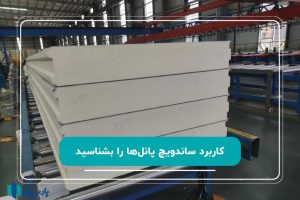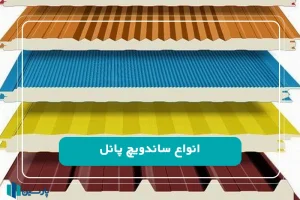
Sandwich panels are a multi-layered product consisting of insulating foam and facing sheets and are used instead of traditional materials for covering roofs and walls. Although the appearance of prefabricated panels is simple and has a clear structure, their production methods are very precise and complex. In this article from Parsin Gostar, we intend to discuss sandwich panel production methods; stay with us.
Raw materials for making sandwich panels
All sandwich panels consist of an inner foam called the insulating core and two metal skins on either side. The material of the insulating foam and the metal skins is the main difference between prefabricated panels and determines their characteristics and applications. The most common materials used for insulating foam are polyurethane foam, polystyrene foam, XPS, glass wool, and rock wool. Galvanized sheets, aluzinc, aluminum, etc. are also used as sandwich coverings. Special adhesives called mastic adhesives are used to attach the foam to metal sheets. The most common materials used for insulating foam are polyurethane foam, polystyrene foam, XPS, glass wool, and rock wool. Galvanized sheets, aluzinc, aluminum, etc. are also used as sandwich coverings. Special adhesives called mastic adhesives are used to attach the foam to metal sheets.
The most important features of insulating foam
All insulating foams have insulating properties and are impervious to water and chemicals. The most important features that can be mentioned for insulating foams are:
- insulation
- Low heat transfer coefficient
- Long life
- style
- Waterproof and chemical resistant
- Long life and durability
- Anti-corrosion and oxidation
- Resistant to heat and direct fire
- High variety in design and color
Features of cover sheets
The covering used for the insulating foam consists of two sheets of sheet metal such as aluminum, aluzinc, galvanized, etc., each of which has specific properties for the prefabricated panel. The most common sheets used to produce sandwich panels are Aluzinc and Galvanized, which have similar properties. The most important properties of these sheets are:
- Resistance to corrosion and oxidation
- Long life
- Proper insulation
- fireproof
- Dyeability
- Low heat transfer coefficient
- Variety in design and color
- Washable
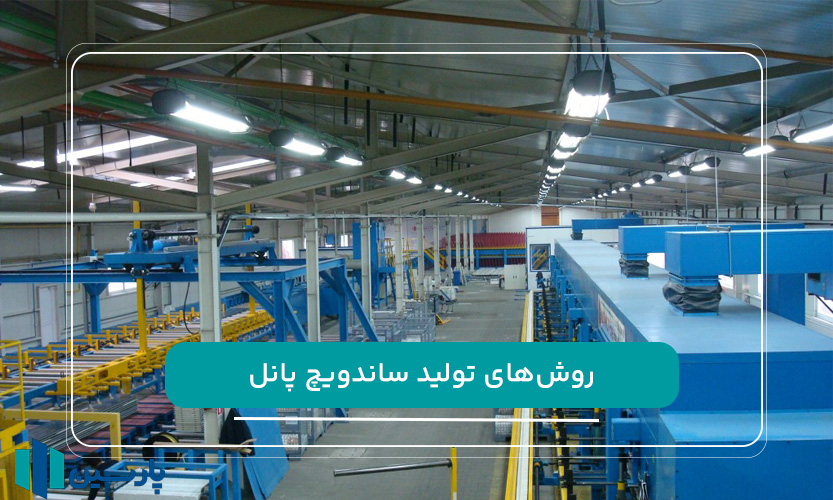
Sandwich panel production methods
There are two types of production lines for producing sandwich panels, which produce these sheets using different methods and designs. Below, we will learn about these methods and the features of each.
Continuous Method (Continuous / Seamless Installation)
This method, as its name suggests, is carried out continuously and in a fully automated manner. In this method, all raw materials, including sheets, foam and adhesive, are placed in a special inlet and produced inside the machine. The sandwich panels are taken out from the outlet according to the program given to the machine in terms of dimensions and thickness of the sandwich panel. In this method, the entire production process takes place inside the machine, and the quality of the panels can only be checked when the product leaves the machine.
The devices that make up the sandwich panel production line in this method are:
- Roll forming machine for forming colored galvanized sheet (roof or wall)
- High pressure two-component or three-component foam injection machine
- Double belt machine (length 25 to 30 meters)
- cutting machine
- Stacking and packaging machine
Such a production line is about 120 meters long. We suggest you take a look at the article Continuous Sandwich Panel Production Line.
Discontinuous Method (Discontinuous / Non-continuous Installation)
Another method used to manufacture prefabricated sandwich panels is the discontinuous method. In this method, each stage of production is designed separately and the entire production line has a staged structure.
In fact, in the production stage, after the end of the work, the output product goes to the next stage for completion. The method of manufacturing ceiling sandwich panels and wall sandwich panels polyurethane and polystyrene are different in this production method and have different production lines.
Discontinuous Polyurethane Panel Production Method
In this method, the sheets are first cut by a roll forming machine, and then the sheets that will be used for the outer layer are placed inside the machine and pressed. In the space between these two sheets, polyurethane foam is injected. In the next stage of production, the polyurethane foam is dried by heating and cooling, and in the final stage, the product is removed from special molds, thus producing the final product.
Discontinuous Polystyrene Panel Production Method
To make this type of panel, all production steps are carried out separately and finally the outputs are placed together and by assembling them, a prefabricated polystyrene panel is produced. In this form of production, galvanized sheets are first cut by a roll forming machine. In another machine, polystyrene foams are cut to the required sizes and thicknesses. The foams are then glued to sheets using special adhesives and pressed.
Manufacturing panels according to customer requirements
As you have read, the production process of prefabricated panels is such that the dimensions, sizes, and thickness of the panels can be changed according to the customer’s needs. This is why there is a high variety in terms of dimensions, sizes, and thickness of the panels, each of which is determined according to its application and efficiency.
summary
Sandwich panels are divided into different types based on the materials used for construction, however, the production process of Types of Sandwich Panels is almost the same. There are two general methods for manufacturing sandwich panels, which include continuous and discontinuous methods. In this article from Parsin Gostar, we have discussed the different methods of producing sandwich panels and the features of each of them. We suggest you visit the Introduction to Sandwich Panels page and become familiar with other concepts.